
“Wait, why does this NFL team have a -235 next to its name? What’s with New England Patriots (-15) vs. Miami Dolphins (+15)? Help! HEEEELPPPP!”
What Line Moves Can Tell Us. After oddsmakers release their opening lines at sportsbooks, the betting public almost immediately reveals which side of the number they like more and moves them accordingly. The most common betting line for a point spread is -110. A -110 line on either side is like paying a tax or commission to the sportsbook. Bettors would pay 10 percent (aka juice) to the sportsbook, which is essentially a fee for brokering the wager. So, the -110 indicates that a bettor must risk $110 to win $100. If you do your homework and search across casinos you can find sportsbooks offering what are called ‘reduced juice ’ or ‘nickel lines’. These are lines that the sportsbook will move to a lower “price” of -105. This basically means they’re reducing their commission from 10% to. What Do the + and – Mean in Sports Betting? The – and + on a sports betting line indicates both your prospective payout and whether you’re betting on the favorite or the underdog. Negative numbers signify the favorite on the betting line. The negative number indicates how much you’d need to bet to win $100. The term “lines” is used a lot in sports betting and it can refer to odds on a bet, or specific lines like the point spread or the over/under total. These lines can change drastically between the time they are initially set by the sportsbook up until when the game actually begins.
If that sounds like you, we’re here to assist you. If you’ve stared at a board at a sportsbook or just seen spreads and moneylines on the Internet and been utterly confused, don’t worry. It’s not just you. Those numbers can be confounding.
But hopefully, once you’re done reading this, you’ll completely understand how they work. As you prepare to dive into the world of sports betting, here’s a breakdown of how the lines work, starting with …
Spreads
It would be really easy to bet on a game if you could put money on a heavy favorite to win.
That’s where point spreads come in. Let’s look at an example:
Philadelphia Eagles (-4.5)
New York Giants (+4.5)
In this case, you can bet on either two outcomes: you can put money on the Eagles to win the game by 4.5 points OR MORE, which makes them the favorites. Or you can bet that the Giants will either win or lose by LESS THAN 4.5 points. They’re the underdogs.
Now, sometimes the spread “moves” during the days leading up to the game. Perhaps the Eagles’ spread ends up being -3.5 (in which they must win by 3.5 points or more to give you a victory in your bet). Your bet all depends on whichever spread you bet on, whether it was when the Eagles were favored by 4.5 or 3.5 points.
If you ever see “PK” or “pick” next to a team, it means there’s no spread and you can bet on who will win, no matter what the score is.
What Does The Line Mean In Sports Betting Odds
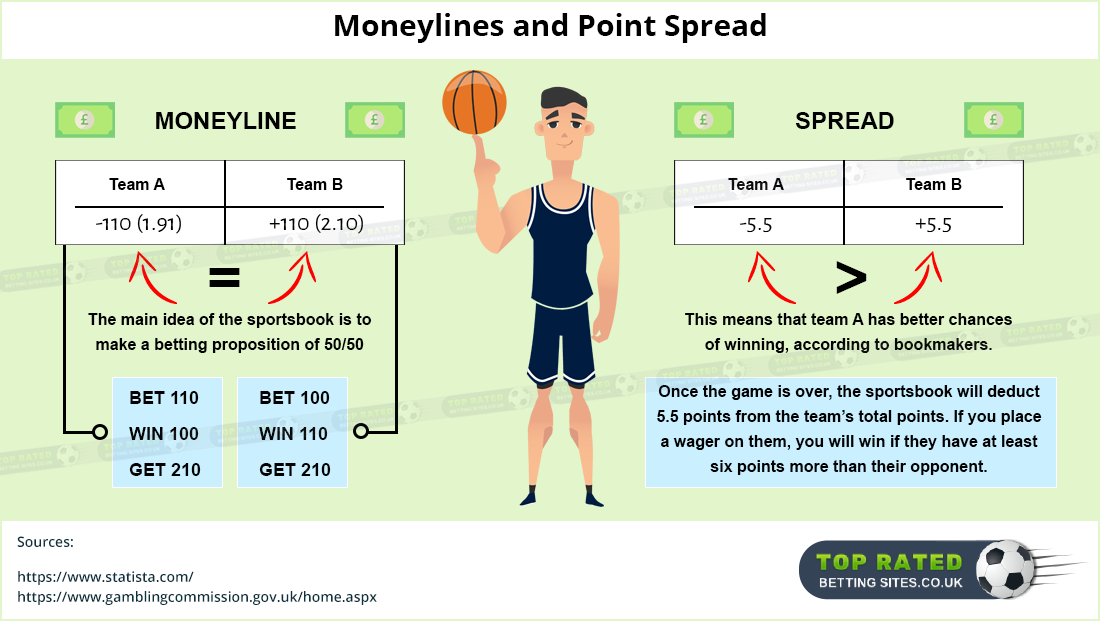
Moneylines
Let’s take that same example above but use moneylines:
Philadelphia Eagles (-200)
New York Giants (+150)
The team with a minus symbol is the favorite, and the number is how much money you would need to bet to win $100. In this case, you would have to bet $200 on the Eagles in order to win an additional $100.
The Giants are the underdogs. If they’re +150, that means you could bet $100 to win $150.
Note that you can bet any amount you want, but those numbers are always calculated and posted the same way, either in how much money you would need to wager to win $100 or how much money you could win by wagering $100.
Odds
If you’re betting on something like the team who will win the Super Bowl in the future, you might see it look like this:
New England Patriots — 3/1
Baltimore Ravens — 5/1
Kansas City Chiefs — 8/1
If you were betting on the Patriots and their 3/1 odds, you would win $3 for every $1 you spend. So if you bet $50 on the Pats and they ended up winning the Super Bowl, you’d win $150 (plus your original wager) back.
Good luck!
As a fan, you don’t care if your team wins by a point or 100. A win is a win, though that 100-point win would be a little easier on the nerves.
In sports betting, how much a team wins by is usually all that matters.
The Latest Line
The most popular way to bet for the two most popular sports, basketball and football, is with the point spread, also known as the “side.” Most baseball, hockey and soccer bets are on the moneyline, which is betting on a team to win straight up with adjusted odds. Football and basketball have moneyline bets available too, but most people will take the point spread.
The concept can be a bit confusing if you’ve never dabbled in sports betting before.
Why bet with the point spread?
The point spread was created to attract more action on a game. When the San Francisco 49ers are expected to blow out the Arizona Cardinals, it’s not enticing to lay $300 to win $100 on a moneyline. But when the 49ers are 11-point favorites and each side is -110 odds? That’s much easier.
What Does +100 Mean In Betting
In that example, the 49ers are spotting the Cardinals 11 points before the game starts, at least for bettors. The 49ers have to win by 12 or more points to cover the spread. If the Cardinals win or lose by 10 or less, that side wins the bet. If the game lands on 11, like a 21-10 49ers win, it’s a push and all bets are refunded. If you see a -11 that means that team is favored, and +11 means you’re taking the underdog.
Nothing sharpens your math skills better than trying to figure out how big your lead as a bettor is if you have a 22.5-point basketball underdog that is losing 90-72.
The problem with the point spread can be when a team — which really doesn’t care that you bet the favorite at -11 — has a 14-point lead but gives up a meaningless score at the end to win by only seven points. They’re still happy with the win. You, as a bettor, are not.
© Provided by Yahoo! Sports Sportsbooks have large boards that display point spreads for all games that day. (AP Photo/John Locher, File)Point spreads lead to bad beats
The most infamous example of a bad beat with the point spread probably came in the 2004 Final Four at the NCAA men’s basketball tournament.
Duke was a 2.5-point underdog against UConn. The Huskies rallied late and took a 79-75 lead on a free throw with 3.2 seconds left. The game itself was over; Duke couldn’t score twice in a few seconds. But Duke guard Chris Duhon pulled up for a running 3-pointer just over the half-court line and banked it in at the buzzer. Duke lost 79-78, but bettors who had Duke and 2.5 points won. March Madness is a huge event for bettors, and reports at the time estimated that Duhon’s “meaningless” shot resulted in a $30 or $40 million swing in Nevada. UConn players celebrated at the final buzzer. UConn bettors doubled over in pain. That’s the difference between betting the moneyline and the point spread.
Baseball and hockey have point spreads too, the “run line” in baseball and “puck line” in hockey. It’s generally 1.5 with odds adjusting accordingly. Taking a big baseball favorite at -1.5 runs can make the odds more palatable. Of course, betting the New York Yankees at -1.5 to bring down the odds from -190 to -110 isn’t too fun when they win 4-3 and you don’t cash a bet.
Betting on the point spread is the most common way to wager on sports. And the first time you take a favorite that wins the game but doesn’t cover the spread, you’ll understand every bettor’s heartbreak.